Drive-in Storage can turn a compact warehouse footprint into dense pallet capacity. It suits operations handling many pallets of the same product, especially where access to every individual pallet is less important than storage density. Picture a forklift entering a deep rack lane, placing pallets from the back forward, and retrieving them in reverse order. That simple flow demands careful planning.
Industry investment trends offer useful context. MHI’s 2024 Annual Industry Report found that 55% of surveyed supply-chain professionals planned to invest more than $1 million in supply-chain technology over the following two years. The finding concerns technology investment broadly, not drive-in racks specifically. It signals growing attention to warehouse efficiency, but it does not prove that one rack type fits every facility. Actual suitability depends on pallet dimensions, inventory rotation, forklift clearances, floor conditions, and operating procedures.
Supplier selection needs the same care. Chinese manufacturers may differ in engineering support, steel specifications, load calculations, quality controls, and export experience. A low quotation alone tells little. Ask for drawings, stated load capacities, inspection records, and references for comparable installations. Then compare the details.
A requested expert quotation should be checked against its original source before publication. No verifiable quotation or source material was provided here, so attributing a statement to a named Drive-in Storage expert would risk misrepresenting them. This guide therefore focuses on practical criteria for identifying and evaluating leading suppliers in China.
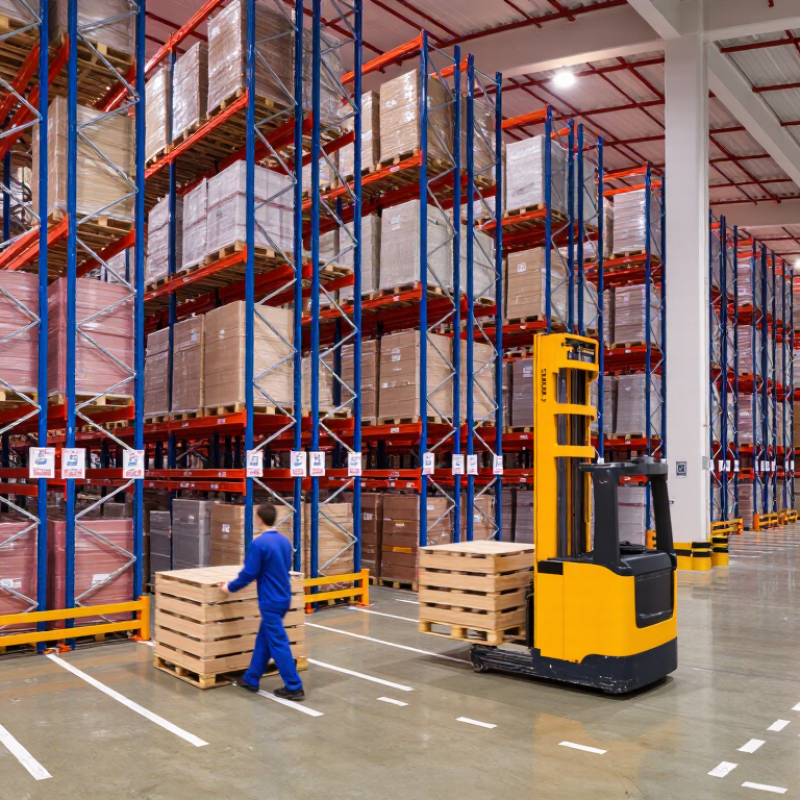
Drive-in storage racks are high-density pallet systems built around deep storage lanes. Instead of placing pallets in separate aisle-facing positions, forklifts travel into the rack structure. Support rails hold pallets at each level, while frames and bracing carry the loads. This design reduces aisle space and creates room for more pallets. Access is less flexible.
A forklift enters a lane and places a pallet on the rails at the required depth. During retrieval, the operator usually removes the nearest pallet before reaching farther into the lane. Many drive-in layouts follow last-in, first-out (LIFO), so the newest pallet is typically retrieved first. This can suit large quantities of the same product when stock rotation rules allow it. Not every warehouse benefits.
Because forklifts move inside the rack, operators need clear sightlines, controlled speed, and pallets with consistent dimensions. Damaged rails, loose bracing, or uneven floors can affect safe operation, so inspections should follow site procedures and the rack supplier’s specifications. Before selecting a system, teams should check load weights, forklift type, lane depth, and access frequency. A dense layout can look efficient on paper. Awkward retrieval may reduce that gain in practice.
Use the technical and procurement criteria below to compare suppliers without relying on company names or unsupported rankings. Rack dimensions and capacities must be confirmed against the project layout, pallet specifications, equipment, and structural design.
| Dimension | How Drive-In Racking Works | What to Check with a Supplier |
|---|---|---|
| Storage principle | A forklift enters a storage lane and places pallets on support rails. The rack structure supports the loads; the forklift travels within the lane during loading and retrieval. | Ask for a layout showing lanes, entry points, upright frames, support rails, and any required aisle or end-of-lane clearances. |
| Inventory rotation | Drive-in racks typically operate on a last-in, first-out (LIFO) basis because pallets are loaded and retrieved from the same end. Drive-through racks can support first-in, first-out (FIFO) flow when accessible from both ends. | Confirm whether the required stock rotation is LIFO or FIFO and whether the proposed design provides access from one end or both. |
| Suitable inventory | Lane-based storage is generally suited to relatively uniform pallet loads, especially when many pallets contain the same product or stock-keeping unit. | Provide pallet dimensions, load weight, overhang, packaging details, and the number of pallets per product so the lane arrangement can be assessed. |
| Storage density | Because forklifts enter the rack lanes, this system can reduce the number of separate access aisles compared with selective pallet racking. The actual space saving depends on the building, lane depth, and operating plan. | Compare the proposed pallet positions and aisle requirements with the existing or alternative layout; do not assess density from lane depth alone. |
| Lane depth | Each lane stores pallets in a sequence from the entrance toward the back. Deeper lanes can increase storage density but may affect selectivity and retrieval time. | Request a lane-depth plan based on forklift reach, pallet dimensions, operating clearances, and the required number of pallet positions. |
| Forklift compatibility | The forklift must enter and operate within the lanes while handling pallets at the intended storage levels. | Check the truck type, overall width and height, turning and lifting requirements, guidance method, and operating clearances against the rack design. |
| Load and structural design | Upright frames, bracing, rails, connections, and floor anchoring must be designed for the specified pallet loads and rack configuration. | Request documented design loads, member and connection details, floor and anchoring requirements, and the design assumptions used for the quotation. |
| Safety features | Rack protection and operational controls help reduce the risk of impact and incorrect pallet placement in areas exposed to forklift traffic. | Discuss upright protectors, entry guides, rail protection, load notices, installation checks, and inspection guidance appropriate to the site. |
| Manufacturing and quality control | Product quality depends on the specified materials, fabrication, surface finish, dimensional control, and inspection process. | Ask for material and coating specifications, inspection records, production quality procedures, and samples or drawings for the components being supplied. |
| Installation and documentation | Correct installation is important for alignment, anchoring, clearances, and the intended load configuration. | Confirm the installation scope, as-built drawings, operating and loading instructions, warranty terms, and recommended inspection schedule. |
| Supplier comparison | A suitable supplier should be able to translate the warehouse requirements into a traceable design and clearly state the limits of that design. | Compare suppliers using the same project brief, pallet data, layout, load assumptions, component specifications, delivery scope, and after-sales requirements. |
Important: There is no single standard capacity or lane depth that applies to every drive-in rack. Obtain a project-specific design and have the proposed system checked against applicable local requirements before installation and use.
Request project drawings, material specifications, inspection records, and references for similar warehouses. A catalog is not enough.
Check bay depth, rail spacing, aisle width, pallet dimensions, and forklift clearance. Small measurements matter.
Ask for calculations covering pallet weight, upright frames, rails, bracing, and floor anchors. Confirm the assumptions match actual loads.
Review weld consistency, upright thickness, protective finishes, and sample measurements against approved drawings. A visit cannot prove real-world performance.
Cold storage may need low-temperature-rated materials and corrosion-resistant finishes. High pallet turnover may require careful forklift access.
They can use floor space efficiently for uniform, slower-moving loads. But access to individual pallets is reduced.
Check whether component costs, installation, safeguards, and service are listed separately. The lowest price may leave out essential support.
Ask who handles damage inspections, replacement parts, and future layout changes. I would verify the schedule twice; plans often change.
Drive-in Storage racks are designed to make efficient use of warehouse space by allowing forklifts to enter the rack structure and place pallets on supporting rails. This high-density system typically works best when goods are stored in larger quantities and managed with a last-in, first-out approach. China’s supplier market includes manufacturers and solution providers with different capabilities, product ranges, and levels of customization, so buyers should compare more than price alone.
When evaluating suppliers, consider structural design, load capacity, materials, production quality, installation support, and the ability to adapt the system to a warehouse’s layout and operating procedures. The right choice depends on factors such as inventory turnover, pallet dimensions, available floor space, forklift type, and future expansion plans. A clear assessment of these needs helps buyers identify a suitable supplier and create a storage solution that balances capacity, safety, and day-to-day efficiency.

 Xinmiao Racking