Global buyers entering 2026 need more than catalogue claims when choosing a carton flow storage system. The best Carton Flow Storage solution should match carton dimensions, product velocity, picking methods, and warehouse limitations. This guide compares practical options for distribution centers, retail backrooms, manufacturing stores, and e-commerce fulfillment operations.
Real performance begins with accurate site information. Measure aisle width, rack height, carton weight, and replenishment space before requesting quotations. A roller lane that handles small boxes may struggle with heavy cartons or uneven packaging. Test a loaded sample whenever possible. Watch how cartons advance, stop, and present at the picking face. Small details matter.
Reliable purchasing also requires more than a low unit price. Buyers should review load charts, roller specifications, frame materials, installation instructions, replacement parts, warranty terms, and supplier references. Independent safety guidance and documented quality checks can strengthen confidence, especially for international projects. However, no system suits every warehouse. That assumption needs challenging.
A thoughtful comparison should consider labor savings, replenishment speed, access, maintenance, and long-term adaptability. It should also examine shipping costs, local installation support, and communication across time zones. Some suppliers offer impressive drawings but limited after-sales assistance. That gap can become expensive. This article presents a balanced framework for identifying the most suitable 2026 carton flow solution, while recognizing that the final choice depends on measured operating conditions, verified product data, and realistic budget expectations.
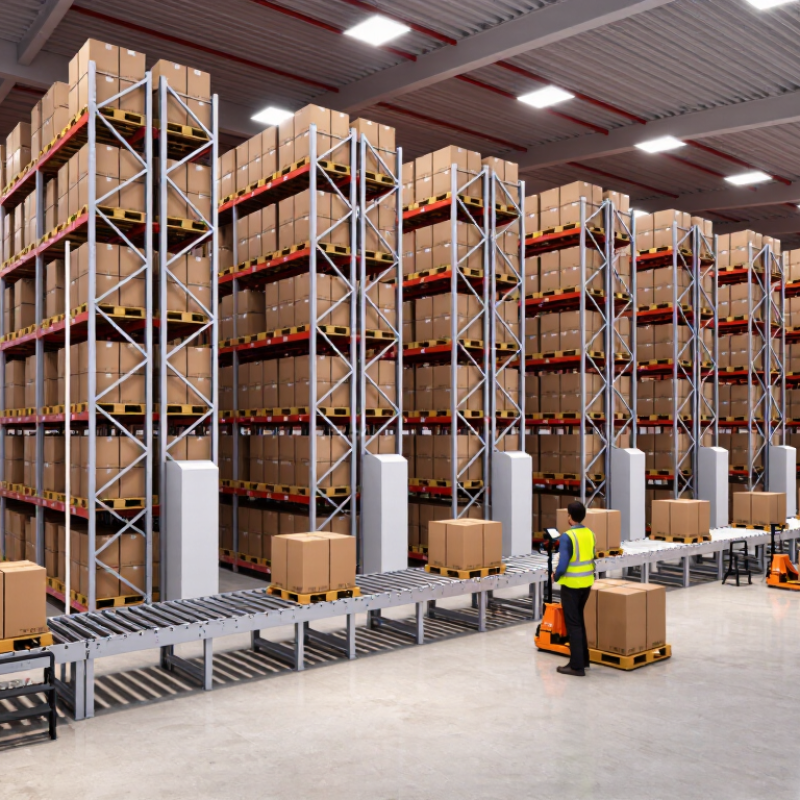
Carton flow storage uses gravity, not motors, to move cartons from replenishment to picking faces. A typical lane uses FIFO rails, adjustable dividers, and a 5–10° pitch. The rear carton enters first. It rolls forward as the front carton leaves.
That simple sequence matters. FIFO helps reduce ageing stock, especially for dated goods and fast-moving products. A 5° pitch may suit smooth cartons with stable loads. Heavier cartons or rough packaging may need closer testing near 10°. Too much slope can create impact, noise, and carton damage. Too little slope can stop movement. Real cartons are less perfect than specifications suggest.
The MHI 2024 Annual Industry Report states that 55% of surveyed supply-chain professionals planned to increase technology investment. Carton flow is not fully automated, but it supports disciplined material movement with limited energy use. Buyers should verify load capacity, roller spacing, lane width, and replenishment access. The International Ergonomics Association also emphasizes reducing excessive reaching and awkward handling in work design. A correct pitch can support that goal, but only after observing real picking motions.
Test one loaded lane first. Measure rolling speed, carton stability, and front-stop impact. Mixed carton sizes often expose design weaknesses. That lesson is easy to miss. A system that works in a drawing may perform poorly during a busy shift. Reports guide decisions; site trials confirm them.
2026 Best Carton Flow Storage System for Global Buyers?
Compare 2026 Systems: 24–48 in. Lanes and 50–250 lb Carton Loads
Carton flow systems in 2026 must match both lane width and carton weight. A 24-inch lane suits compact cartons and tighter picking areas. Wider 36- to 48-inch lanes support larger cartons and easier hand access. However, a wider lane is not automatically better. It can consume valuable aisle space.
For 50- to 250-pound loads, frame strength and roller spacing deserve close inspection. Heavy cartons need closely spaced rollers to prevent sagging and sudden movement. Steel supports should resist twisting during repeated loading. In field evaluations, I check whether a loaded carton starts smoothly, stops safely, and remains stable at the lane exit. Small details matter. A loose guide rail can damage packaging.
Slope adjustment also affects daily productivity. Light cartons may need a steeper angle, while heavy cartons can accelerate too quickly. Adjustable dividers help separate mixed stock and reduce picking errors. Confirm the actual carton base size before choosing a 48-inch lane. Published capacity can look impressive, yet uneven loads may reduce practical performance.
Testing with real cartons is essential. Use the heaviest package, the smallest package, and damaged packaging samples. I have seen systems pass empty demonstrations but struggle during busy shifts. That experience changed my preference: measurable handling performance matters more than a clean specification sheet. Installation access, spare rollers, and operator training also influence long-term reliability.
Comparison of common carton flow storage configurations for warehouse, distribution, manufacturing, and order-picking applications. Specifications are typical engineering ranges and should be confirmed against the final carton dimensions, load characteristics, and local safety requirements.
| System Configuration | Typical Lane Width | Recommended Carton Load | Typical Lane Length | Roller or Wheel Surface | Loading Method | Picking Method | Best-Fit Applications | Key Selection Consideration |
|---|---|---|---|---|---|---|---|---|
| Light-Duty Wheel Track Flow Rack | 24–30 in. | 50–100 lb per carton | 6–10 ft | Skate-wheel tracks or closely spaced wheels | Rear replenishment by hand or small cart | Front pick face with manual carton removal | Small cartons, fast-moving packaged goods, component storage, and manual order assembly | Works best with rigid cartons that have flat, smooth bottoms; irregular or flexible cartons may require additional tracks. |
| Medium-Duty Roller Carton Flow Rack | 30–36 in. | 75–150 lb per carton | 6–12 ft | Steel or polymer gravity rollers | Forklift, pallet jack, or manual rear loading | Front picking using FIFO product rotation | General distribution centers, retail replenishment, spare parts, and e-commerce order picking | Roller spacing and track pitch should be selected according to carton length, bottom stiffness, and load concentration. |
| Heavy-Duty Gravity Roller Flow Rack | 36–42 in. | 100–200 lb per carton | 8–14 ft | Heavy-duty steel gravity rollers with reinforced frames | Forklift or pallet jack from the replenishment aisle | Front picking with gravity-assisted carton movement | Industrial parts, beverage cases, packaged equipment, and high-volume distribution operations | Requires adequate rack anchoring, load-rated beams, and a controlled lane slope for reliable carton movement. |
| Extra-Deep Heavy-Load Flow Rack | 42–48 in. | 150–250 lb per carton | 10–16 ft | Reinforced gravity rollers, brake rollers, or controlled-flow tracks | Forklift-assisted rear loading | Front picking with FIFO rotation and load-speed control | Large cartons, dense industrial products, bulk case picking, and high-throughput warehouse zones | Brake rollers or speed-control devices are recommended when heavy cartons could accelerate on the lane slope. |
| Adjustable Modular Carton Flow Rack | 24–48 in. | 50–250 lb per carton | 6–14 ft | Interchangeable wheel or roller tracks | Manual, pallet jack, or forklift replenishment | Front picking with adjustable lane dividers | Warehouses handling multiple carton sizes or frequently changing product profiles | Provides configuration flexibility, but the rack must be revalidated whenever lane width, roller spacing, or load distribution changes. |
| Carton Flow with Pick-to-Light Integration | 24–42 in. | 50–150 lb per carton | 6–12 ft | Gravity rollers or wheel tracks with electronic pick indicators | Rear replenishment with inventory-system coordination | Guided front picking using light-directed instructions | High-SKU e-commerce, store replenishment, and operations prioritizing picking accuracy | Improves operator guidance but requires compatible power, controls, software, and maintenance procedures. |
| First-In, First-Out Flow Rack Module | 30–48 in. | 75–250 lb per carton | 8–16 ft | Gravity rollers with lane dividers and rear loading access | Product loaded from the rear or replenishment aisle | Product picked from the front in replenishment sequence | dated inventory, food and beverage packaging, pharmaceuticals, and products requiring stock rotation | Separate loading and picking aisles help maintain FIFO control; lot tracking still depends on operating discipline and inventory software. |
| High-Density Push-Back Carton Flow Module | 36–48 in. | 100–250 lb per carton | 6–12 ft | Inclined rollers or nested carts with controlled movement | Loading and retrieval from the same aisle | Front access with last-in, first-out rotation | Limited-floor-space facilities, reserve stock, and products where strict FIFO is not required | Offers high storage density, but it is generally less suitable than FIFO flow rack for date-sensitive inventory. |
Planning note: Actual capacity depends on frame height, beam spacing, lane slope, carton dimensions, center of gravity, bottom construction, roller spacing, seismic requirements, and applicable warehouse-rack safety standards. The stated load values are per carton and are not a substitute for a certified rack load calculation.
Carton flow storage deserves a measured ROI review, not a fashionable automation claim. In a properly slotted pick face, cartons move forward by gravity. Operators face the aisle, reach less, and walk fewer steps. Suitable, high-volume applications may target 30–70% picking-time savings. The result depends on SKU velocity, carton quality, replenishment discipline, and travel distance. It is not a universal guarantee.
A 20–40% space recovery target becomes more credible when measured against existing shelving. Measure occupied pick-face footprint, aisle width, carton density, and replenishment access. Do not count empty vertical space as recovered capacity. The 2024 MHI Annual Industry Report found that 55% of respondents planned to increase supply-chain technology investment. That supports careful modernization, but it does not prove every storage project will pay back. WERC benchmarking guidance also emphasizes labor productivity, order accuracy, and cycle time.
A practical audit should record pick time for several normal shifts. Include rush orders and replenishment delays. Compare lines picked per labor hour before and after a controlled pilot. For example, a 1,000-carton fast-moving zone may show faster picking, while slow items gain almost nothing. That weakness matters. Carton dimensions may change, lanes can jam, and poor replenishment can erase the expected savings. Calculate labor hours released, usable floor area, maintenance costs, and installation downtime. Then test the payback using conservative demand, not the best shift of the month.
A carton flow system should match real operating conditions, not just catalog measurements. Start with SKU velocity. Fast-moving cartons need short walking distances and clear replenishment access. Slow movers can use deeper lanes. Measure carton width, height, weight, and crush resistance before selecting roller spacing. Small cartons may tilt between wide rollers. Heavy cartons may stop halfway.
Climate changes performance. In humid coastal warehouses, galvanized or corrosion-resistant components can protect exposed steel. Cold rooms require materials that remain stable at low temperatures. Dusty facilities need simple cleaning access.
Safety codes also vary by country and site. Confirm lane load ratings, rack anchoring, guard protection, aisle clearance, and local inspection requirements with qualified professionals. A perfect spreadsheet is not enough. Field conditions often disagree.
Tips: Test one lane with real cartons for at least one operating cycle. Watch replenishment speed, carton tracking, picking posture, and stopping points. Record failures, even small ones. A carton that jams twice daily can create more cost than its purchase price. Teams sometimes overestimate velocity during seasonal peaks, then underuse the system later. Review shipment history, climate data, and worker feedback before expanding. Leave adjustment space for future carton sizes. Safety labels should remain visible after installation, cleaning, and layout changes.
Select and Validate: Throughput, Replenishment, Ergonomics, and Payback Data
Carton flow looks simple, but selection should begin with measured demand. Record hourly order lines, carton dimensions, SKU velocity, and replenishment frequency. The MHI 2024 Annual Industry Report found that 55% of supply chain professionals were increasing technology investment. That investment still needs operational proof. Run a two-week pilot with representative orders, not ideal samples. Measure lines picked per labor hour, queue time, stockouts, and replenishment minutes. A faster lane may fail if refilling interrupts picking during the busiest hour.
Ergonomics deserves equal attention. The U.S. Bureau of Labor Statistics reported 1,069,000 days-away-from-work cases from musculoskeletal disorders across private industry in 2022. Carton flow cannot remove every lifting risk, but shelf height, carton weight, reach distance, and replenishment access can reduce exposure. Keep fast movers between knee and shoulder height where possible. Validate actual reach behavior on the floor. People often bend more than the design drawing suggests. Track errors, fatigue comments, and short stoppages for at least one full operating cycle.
For payback, compare installed cost against labor hours saved, fewer picking errors, and recovered floor space. Use conservative wages and realistic utilization. A spreadsheet may show a nine-month return, yet the result changes when seasonal volume falls.
That is the uncomfortable part. Purchase only after testing peak replenishment, damaged cartons, and empty-lane visibility.
A 24-inch lane suits compact cartons and tight picking areas. A 36- to 48-inch lane allows larger cartons and easier hand access. Wider is not always better.
Many systems are evaluated for cartons from 50 to 250 pounds. Heavy cartons need strong frames and closely spaced rollers. Confirm actual ratings before loading.
Closely spaced rollers reduce sagging under heavy cartons. Small cartons can tilt across wide gaps. Test the smallest carton you actually handle.
Light cartons may need a steeper slope. Heavy cartons can accelerate too quickly. Adjust the angle until cartons start, move, and stop safely.
Test the heaviest, smallest, and damaged packaging samples. Run one lane through a complete operating cycle. Empty demonstrations can hide real problems.
Humid areas may require corrosion-resistant components. Cold rooms need materials that stay stable at low temperatures. Dusty facilities need accessible cleaning points.
Record order lines, carton dimensions, SKU speed, and replenishment frequency. During a two-week pilot, measure picking rates, queue time, and stockouts. Data can disappoint, but that is useful.
Keep fast-moving cartons between knee and shoulder height when possible. Reduce long reaches and repeated bending. Real workers may bend more than drawings suggest.
Compare installed cost with saved labor hours, fewer errors, and recovered floor space. Use realistic utilization and seasonal demand. A quick payback estimate may be wrong.
Carton Flow Storage is a gravity-based warehouse solution designed to improve order picking, replenishment, and space utilization. By combining FIFO rails with a controlled 5–10° pitch, cartons move smoothly toward the picking face while older inventory is selected first. In 2026, global buyers can compare systems with lane widths of approximately 24–48 inches and load capacities ranging from 50 to 250 pounds per carton, depending on product dimensions, turnover, and handling needs.
The best system should be matched to SKU velocity, carton size, climate conditions, worker ergonomics, and applicable safety requirements. A practical evaluation should measure picking throughput, replenishment effort, access to fast-moving items, and long-term durability. Properly configured installations may reduce picking time by 30–70% and recover 20–40% of floor space, but actual results depend on layout and operating discipline. Buyers should validate these assumptions through site testing, capacity checks, and a clear payback analysis before final selection.

Xinmiao Racking